State Reference Guide
Nursing License Renewal Requirements by State — 2026 Complete Guide
CE hours, renewal cycles, NLC compact status, grace periods, and renewal fees for all 50 states. Verified May 2026. Always confirm current requirements with your state nursing board before renewing.
By RenewOps Editorial Team
Written by the RenewOps team — operations and compliance professionals who have helped small teams track licenses, contracts, and certifications across healthcare, construction, and financial services.
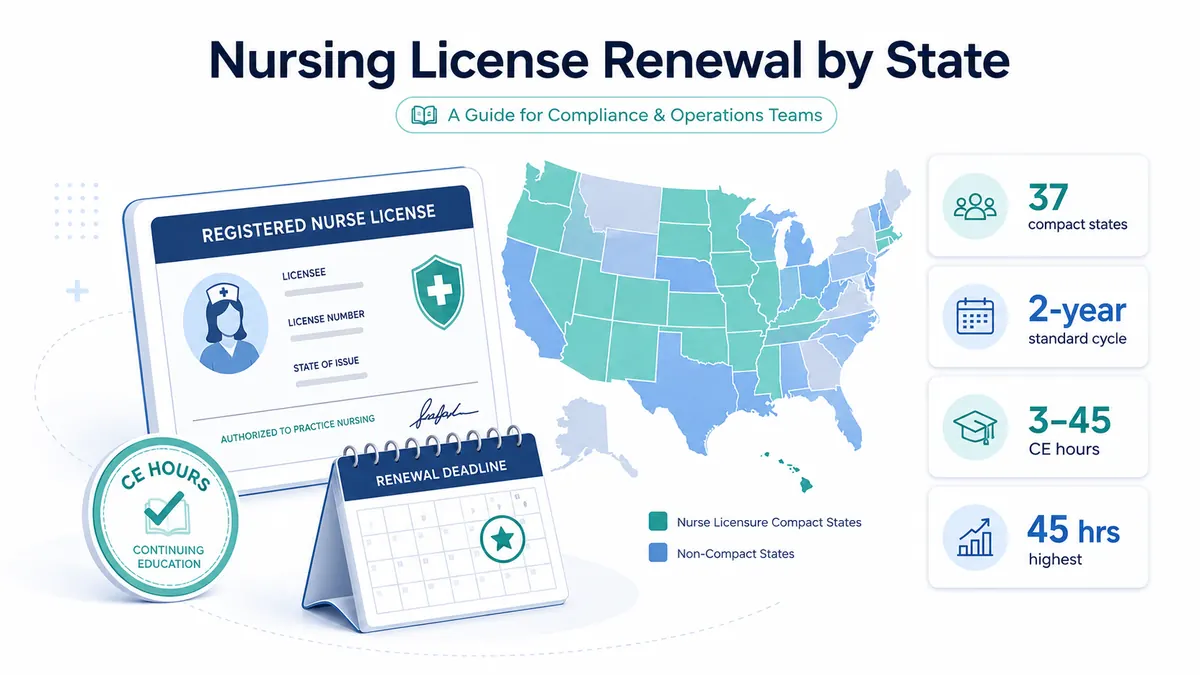
NLC Compact states
37
of 50 states
Standard renewal cycle
2 years
46 of 50 states
CE hours range
3–45 hrs
avg 28 hrs / cycle
Highest CE requirement
45 hrs
Washington
Key insights across all 50 states
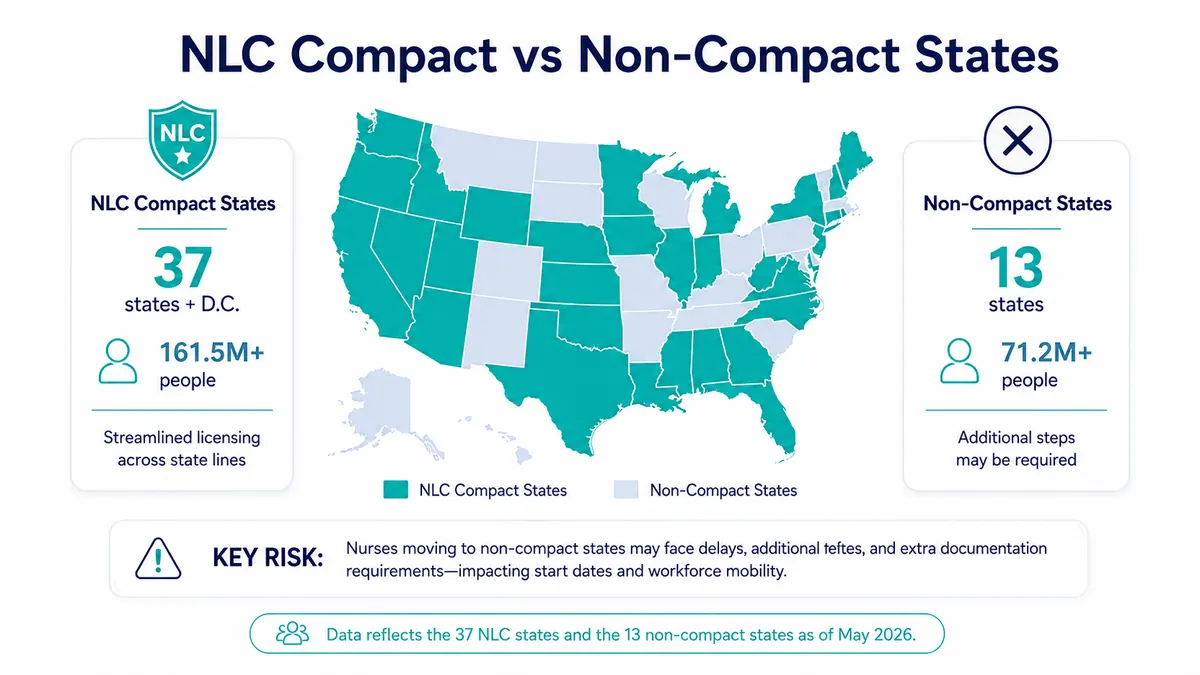
13 states require a separate license
California, New York, Illinois, Alaska, Hawaii, Oregon, Washington, Nevada, Minnesota, Connecticut, Massachusetts, Rhode Island, and Vermont are not NLC members. Nurses must obtain a separate license in each non-compact state.
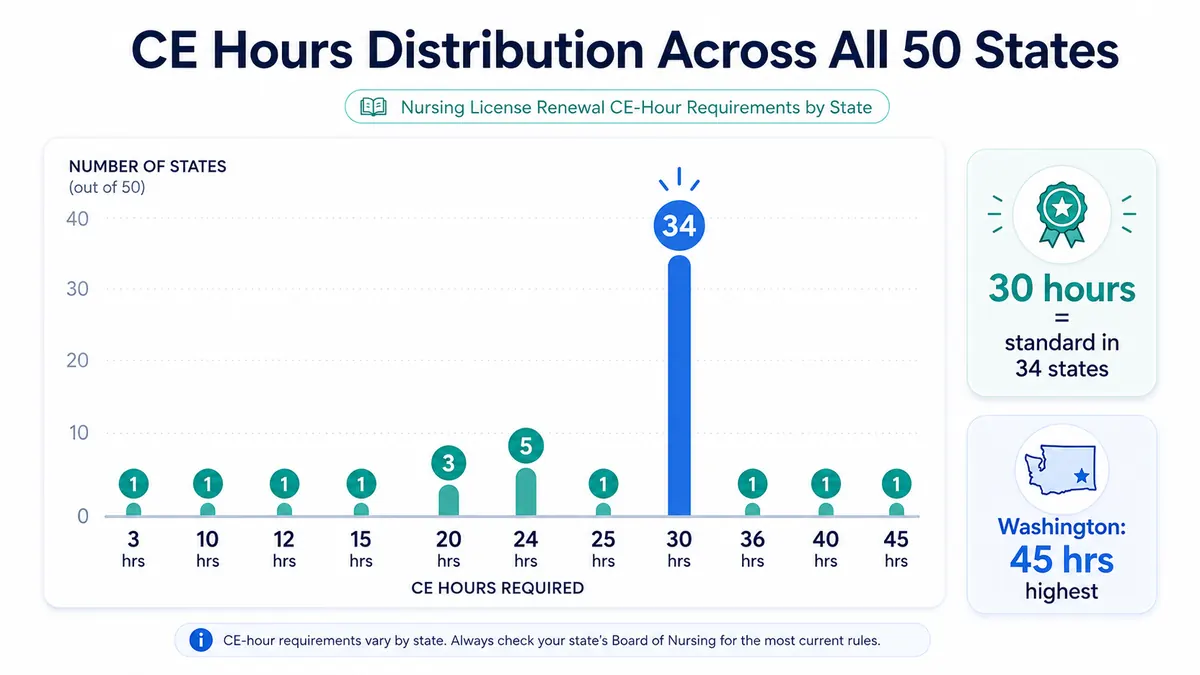
Texas requires only 20 CE hours — lowest among large states
Texas and Nebraska both require just 20 CE hours per 2-year cycle. This is 33% fewer hours than the most common requirement of 30 hours, but Texas still requires a mandatory jurisprudence exam each cycle.
Washington State requires 45 CE hours — highest in the US
Washington State has the highest CE requirement at 45 hours per 2-year cycle — 50% more than the national standard. Mississippi is second at 40 hours. Both are non-compact or have other distinctive requirements.
New York and Iowa use a 3-year renewal cycle
New York and Iowa are the only states with 3-year renewal cycles. New York requires only specific mandatory CE topics (3 hrs infection control, 2 hrs child abuse) rather than a total CE hour minimum.
A lapsed compact home state license suspends privileges in all 41 member states simultaneously
This is the most critical risk for travel nurses and multi-state practitioners. A single missed renewal deadline doesn't just affect one state — it effectively suspends practice privileges across the entire compact at once.
CE hours distribution across all 50 states
Number of states requiring each CE hour total. 30 hours is the clear standard.
NLC compact status by state
Compact states (37) — one license, multistate practice
Non-compact states (13) — separate license required in each
Compact lapse rule
If a nurse's home state license lapses, compact privileges in all 36 other member states are suspended simultaneously — not just the home state. This is the most consequential single-point-of-failure in multi-state nursing practice.
Renewal cycle breakdown
2-year cycle
48 states (92%)
AL, AK, AZ, AR, CA, CO, CT, DE, FL, GA, HI, ID, IL, IN, KS, KY, LA, ME, MD, MA, MI, MN, MS, MO, MT, NE, NV, NH, NJ, NM, NC, ND, OH, OK, OR, PA, RI, SC, SD, TN, TX, UT, VT, VA, WA, WV, WI, WY
3-year cycle
2 states (4%)
Iowa, New York
States with non-standard requirements
California
2 years · 30 CE hrs · Non-compactNon-compact — requires CA-specific license
CE notes: 2 hrs geriatric care for RNs 65+
Florida
2 years · 24 CE hrs · NLC CompactHIV/AIDS training required at initial licensure
CE notes: 2 hrs HIV/AIDS (initial); 2 hrs med errors
Illinois
2 years · 20 CE hrs · Non-compactNon-compact; sexual harassment training mandatory
CE notes: Sexual harassment prevention training required
Iowa
3 years · 36 CE hrs · NLC Compact3-year renewal cycle — less common
Massachusetts
2 years · 15 CE hrs · Non-compactNon-compact; lowest CE requirement in US
Mississippi
2 years · 40 CE hrs · NLC CompactHighest CE requirement at 40 hours
New York
3 years · 3 CE hrs · Non-compact3-year cycle; non-compact; mandatory topic CE only
CE notes: 3 hrs infection control; 2 hrs child abuse ID (mandatory topics)
North Dakota
2 years · 12 CE hrs · NLC CompactLow CE requirement at 12 hours
Oregon
2 years · 30 CE hrs · Non-compactNon-compact; higher renewal fee
Texas
2 years · 20 CE hrs · NLC CompactJurisprudence exam required each cycle
CE notes: 1 hr jurisprudence exam required
Vermont
2 years · 30 CE hrs · Non-compactNon-compact; higher renewal fee
Washington
2 years · 45 CE hrs · Non-compactNon-compact; highest CE requirement at 45 hours
LPN / LVN and APRN — important differences
LPN/LVN licenses follow the same 2-year renewal cycle as RN licenses in most states and are covered by the Nurse Licensure Compact. CE hour requirements are typically identical to RN requirements in the same state, though some states set different totals. Verify with your state board.
APRN / Nurse Practitioner licenses are not covered by the NLC. APRNs must hold a separate active license in every state where they practice, plus maintain national certification (ANCC or AANP). ANCC certification renews every 5 years (1,000 clinical hours + 75 CE hours). AANP certification renews every 5 years (100 CE hours). These requirements are in addition to state RN license renewal.
Nursing license renewal by state — top 10 states
Detailed requirements for the most searched states. All 50 states in the full table below.
California RN License Renewal Requirements
Non-compactCalifornia is not a member of the Nurse Licensure Compact — nurses must hold a California-specific RN license to practice in the state. Out-of-state compact licenses are not valid in California. 30 CE hours are required per 2-year cycle; nurses over 65 may have additional geriatric care CE requirements. The BRN processes renewals online through BreEZe. California's 30-day grace period is shorter than most states — nurses should begin the renewal process 60 days before expiration.
New York RN License Renewal Requirements
Non-compact · 3-year cycleNew York is unique — it uses a 3-year renewal cycle and does not set a total CE hour requirement. Instead, nurses must complete 3 mandatory contact hours in infection control and 2 mandatory hours in child abuse identification each cycle. Additional voluntary CE hours are not required by the state. New York is not a compact state. The 90-day grace period is one of the longest in the US.
Texas RN License Renewal Requirements
NLC CompactTexas requires only 20 CE hours per 2-year cycle — one of the lowest requirements among large states. However, Texas mandates a jurisprudence exam (online, open-book) each renewal cycle covering Texas nursing law. Texas is a compact state, so Texas RN licenses are valid for practice in all 41 NLC member states. Renewal fees are among the lowest nationally at $58–$68.
Florida RN License Renewal Requirements
NLC CompactFlorida requires 24 CE hours per 2-year cycle, including 2 mandatory hours on medical errors. HIV/AIDS training (2 hours) is required at initial licensure only, not at each renewal. Florida is a compact state. Renewal is handled through the Department of Health's online portal.
Pennsylvania RN License Renewal Requirements
NLC CompactPennsylvania requires 30 CE hours per 2-year cycle, including 2 mandatory hours on patient safety and 2 mandatory hours on child abuse recognition and reporting. Pennsylvania joined the NLC compact, allowing PA nurses to practice in all member states. Fees are low compared to neighboring Northeast states.
Illinois RN License Renewal Requirements
Non-compactIllinois requires only 20 CE hours per 2-year cycle and has one of the lowest renewal fees nationally ($40–$50). However, Illinois mandates sexual harassment prevention training as part of CE requirements. Illinois is not a compact state — nurses practicing in Illinois must hold an Illinois-specific license. Renewal is managed through IDFPR's online portal.
Ohio RN License Renewal Requirements
NLC CompactOhio requires 24 CE hours per 2-year cycle and offers a 90-day grace period — one of the longest in the US alongside Maryland and New York. Ohio is a compact state. Licenses renew based on birth month. Ohio's renewal fee is among the lowest for Midwest states.
Georgia RN License Renewal Requirements
NLC CompactGeorgia follows the standard 30 CE hours per 2-year cycle with no mandatory topic requirements beyond standard approval criteria. Georgia is a compact state with competitive renewal fees. Licenses renew based on birth month through the Georgia Secretary of State's professional licensing portal.
North Carolina RN License Renewal Requirements
NLC CompactNorth Carolina requires 30 CE hours per 2-year cycle with no mandatory topic requirement. NC is a compact state and is a major employment hub for travel nurses, particularly around the Research Triangle and Charlotte metro areas. NCBON provides a public license lookup for primary source verification.
Washington State RN License Renewal Requirements
Non-compactHighest CE: 45 hrsWashington State requires 45 CE hours per 2-year cycle — the highest requirement in the United States, 50% above the national standard of 30 hours. Washington is not a compact state, requiring a separate WA license for out-of-state nurses practicing in Washington. Staffing agencies placing nurses in Washington should budget additional time and cost for CE completion.
All 50 states — complete requirements table
Filter by compact status, renewal cycle, or CE hour range. Data verified May 2026 — always confirm with your state board before renewal.
Showing 50 of 50 states
| State | CE hours | NLC Compact | Cycle | Renewal date | Fee | Grace |
|---|---|---|---|---|---|---|
| Alabama ABSN | 24 hrs | ✓ Yes | 2 years | Birth month | $85–$100 | 60d |
| Alaska ASBN | 30 hrs | ✗ No | 2 years | Birth month | $175–$200 | 30d |
| Arizona AZBN | 30 hrs | ✓ Yes | 2 years | Birth month | $65–$75 | 60d |
| Arkansas ARSBN | 30 hrs | ✓ Yes | 2 years | Birth month | $65–$80 | 60d |
| California BRN Non-compact — requires CA-specific license 2 hrs geriatric care for RNs 65+ | 30 hrs | ✗ No | 2 years | Birth month | $130–$150 | 30d |
| Colorado DORA | 30 hrs | ✓ Yes | 2 years | Birth month | $56–$65 | 30d |
| Connecticut DPH | 24 hrs | ✗ No | 2 years | Calendar year | $90–$110 | 60d |
| Delaware DBON | 30 hrs | ✓ Yes | 2 years | Birth month | $78–$88 | 60d |
| Florida FLBN HIV/AIDS training required at initial licensure 2 hrs HIV/AIDS (initial); 2 hrs med errors | 24 hrs | ✓ Yes | 2 years | Birth month | $65–$80 | 60d |
| Georgia GBN | 30 hrs | ✓ Yes | 2 years | Birth month | $65–$75 | 60d |
| Hawaii HBON | 30 hrs | ✗ No | 2 years | Calendar year | $70–$90 | 30d |
| Idaho IBON | 30 hrs | ✓ Yes | 2 years | Birth month | $80–$100 | 60d |
| Illinois IDFPR Non-compact; sexual harassment training mandatory Sexual harassment prevention training required | 20 hrs | ✗ No | 2 years | Calendar year | $40–$50 | 60d |
| Indiana ISN | 30 hrs | ✓ Yes | 2 years | Birth month | $50–$60 | 60d |
| Iowa IEB 3-year renewal cycle — less common | 36 hrs | ✓ Yes | 3 years | Birth month | $90–$105 | 30d |
| Kansas KSBN | 30 hrs | ✓ Yes | 2 years | Birth month | $70–$80 | 60d |
| Kentucky KBN | 30 hrs | ✓ Yes | 2 years | Birth month | $70–$85 | 60d |
| Louisiana LSBN | 30 hrs | ✓ Yes | 2 years | Birth month | $60–$75 | 60d |
| Maine MBON | 30 hrs | ✓ Yes | 2 years | Birth month | $70–$80 | 60d |
| Maryland MBON | 30 hrs | ✓ Yes | 2 years | Birth month | $70–$80 | 90d |
| Massachusetts BORN Non-compact; lowest CE requirement in US | 15 hrs | ✗ No | 2 years | Birth month | $110–$130 | 60d |
| Michigan LARA | 25 hrs | ✓ Yes | 2 years | Birth month | $20–$30 | 60d |
| Minnesota MBON | 30 hrs | ✗ No | 2 years | Birth month | $85–$105 | 30d |
| Mississippi MSBN Highest CE requirement at 40 hours | 40 hrs | ✓ Yes | 2 years | Birth month | $90–$110 | 60d |
| Missouri MOSBN | 30 hrs | ✓ Yes | 2 years | Birth month | $80–$95 | 60d |
| Montana MBON | 24 hrs | ✓ Yes | 2 years | Birth month | $90–$105 | 30d |
| Nebraska NBON | 20 hrs | ✓ Yes | 2 years | Birth month | $115–$130 | 30d |
| Nevada NSBN | 30 hrs | ✗ No | 2 years | Birth month | $90–$110 | 30d |
| New Hampshire NHBON | 30 hrs | ✓ Yes | 2 years | Birth month | $110–$130 | 60d |
| New Jersey NJBON | 30 hrs | ✓ Yes | 2 years | Calendar year | $110–$130 | 60d |
| New Mexico NMSBN | 30 hrs | ✓ Yes | 2 years | Birth month | $70–$80 | 60d |
| New York NYS ED 3-year cycle; non-compact; mandatory topic CE only 3 hrs infection control; 2 hrs child abuse ID (mandatory topics) | 3 hrs | ✗ No | 3 years | Birth month | $138–$148 | 90d |
| North Carolina NCBON | 30 hrs | ✓ Yes | 2 years | Birth month | $70–$80 | 60d |
| North Dakota NDBON Low CE requirement at 12 hours | 12 hrs | ✓ Yes | 2 years | Birth month | $90–$110 | 30d |
| Ohio OSBN | 24 hrs | ✓ Yes | 2 years | Birth month | $60–$70 | 90d |
| Oklahoma OSBN | 30 hrs | ✓ Yes | 2 years | Birth month | $90–$110 | 60d |
| Oregon OBN Non-compact; higher renewal fee | 30 hrs | ✗ No | 2 years | Birth month | $175–$195 | 60d |
| Pennsylvania PBON 2 hrs patient safety; 2 hrs child abuse | 30 hrs | ✓ Yes | 2 years | Birth month | $60–$70 | 60d |
| Rhode Island RIBON | 10 hrs | ✗ No | 2 years | Calendar year | $125–$145 | 60d |
| South Carolina SCBON | 30 hrs | ✓ Yes | 2 years | Birth month | $70–$80 | 60d |
| South Dakota SDSN | 30 hrs | ✓ Yes | 2 years | Birth month | $105–$120 | 30d |
| Tennessee TN BON | 30 hrs | ✓ Yes | 2 years | Birth month | $90–$105 | 60d |
| Texas TBON Jurisprudence exam required each cycle 1 hr jurisprudence exam required | 20 hrs | ✓ Yes | 2 years | Birth month | $58–$68 | 60d |
| Utah DOPL | 30 hrs | ✓ Yes | 2 years | Birth month | $50–$62 | 30d |
| Vermont VTBON Non-compact; higher renewal fee | 30 hrs | ✗ No | 2 years | Birth month | $175–$195 | 60d |
| Virginia VBON | 30 hrs | ✓ Yes | 2 years | Birth month | $60–$70 | 60d |
| Washington WSNC Non-compact; highest CE requirement at 45 hours | 45 hrs | ✗ No | 2 years | Birth month | $80–$95 | 60d |
| West Virginia WVBON | 30 hrs | ✓ Yes | 2 years | Birth month | $75–$88 | 60d |
| Wisconsin WI DSPS | 30 hrs | ✓ Yes | 2 years | Birth month | $75–$90 | 60d |
| Wyoming WYBON | 30 hrs | ✓ Yes | 2 years | Birth month | $90–$105 | 30d |
Non-compact — requires CA-specific license
2 hrs geriatric care for RNs 65+
HIV/AIDS training required at initial licensure
2 hrs HIV/AIDS (initial); 2 hrs med errors
Non-compact; sexual harassment training mandatory
Sexual harassment prevention training required
3-year renewal cycle — less common
Non-compact; lowest CE requirement in US
Highest CE requirement at 40 hours
3-year cycle; non-compact; mandatory topic CE only
3 hrs infection control; 2 hrs child abuse ID (mandatory topics)
Low CE requirement at 12 hours
Non-compact; higher renewal fee
Jurisprudence exam required each cycle
1 hr jurisprudence exam required
Non-compact; higher renewal fee
Non-compact; highest CE requirement at 45 hours
State names link to official board websites. CE hours per renewal cycle. Always verify with your state board before renewing.
✓ Compact rows highlighted. Board links open official state board websites. CE hours are per renewal cycle.
Operations guide
How to use this data if you manage a nursing team
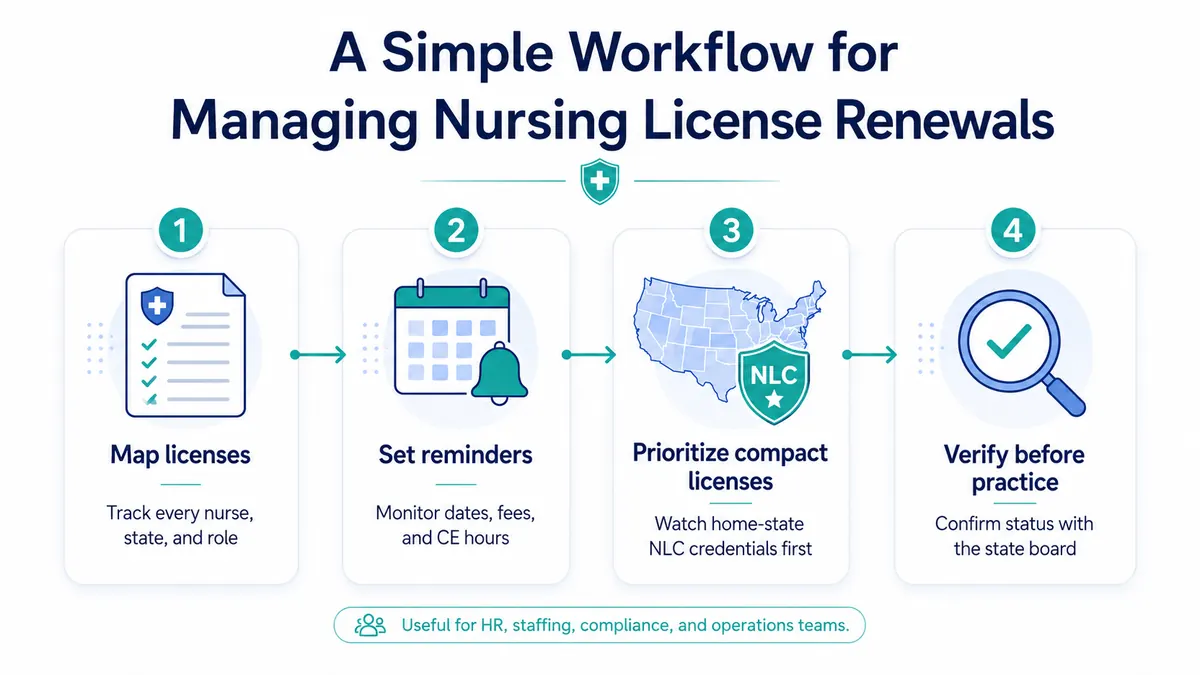
Map each nurse to their home state and any non-compact states
For compact states: one tracking record per nurse (home state license). For non-compact states: one record per nurse per state license. A nurse with licenses in CA, NY, and TX needs 3 separate records — one for each.
Set reminders based on each state's renewal cycle and CE requirements
Most nurses renew every 2 years. Set 90-day, 60-day, and 30-day reminders. For CE-heavy states (WA: 45 hrs, MS: 40 hrs), add a 6-month reminder to check CE completion progress.
Flag compact home state licenses as highest-priority
A lapsed compact license suspends practice in all 41 member states simultaneously. For travel nurses or multi-state practitioners, treat the home state license as the single most critical record in your system.
Verify license status directly with state board at renewal
Don't rely solely on the nurse's self-reported renewal confirmation. Use each state board's public license lookup (Nursys for NLC states) to verify active status. This is primary source verification and required by The Joint Commission for healthcare facilities.
Renewal fee ranges by region
Midwest
$20–$130
Michigan lowest ($20–30), Iowa highest ($90–105)
IL, IN, IA, KS, MI, MN, MO, NE, ND, OH, SD, WI
South
$58–$110
Utah and Texas among lowest nationally
AL, AR, DE, FL, GA, KY, LA, MD, MS, NC, OK, SC, TN, TX, VA, WV
West
$50–$200
Alaska and Oregon highest; Colorado and Utah lowest
AK, AZ, CA, CO, HI, ID, MT, NV, NM, OR, UT, WA, WY
Northeast
$90–$200
Vermont and Oregon highest; Pennsylvania lowest
CT, MA, ME, NH, NJ, NY, PA, RI, VT
Fee ranges are for standard RN renewal. Late fees and reinstatement fees are additional.
Frequently asked questions
Most states require RN license renewal every 2 years. Iowa and New York are the main exceptions — Iowa renews on a 3-year cycle, and New York also uses a 3-year cycle. A small number of states use 1-year cycles for specific license types. The renewal date is typically tied to the nurse's birth month or the original license issue date.
CE hour requirements vary by state: Massachusetts requires just 15 hours, North Dakota requires 12 hours, and Rhode Island requires 10 hours — on the low end. Texas requires 20 hours. Most states require 30 hours per 2-year cycle. Mississippi requires the most at 40 hours, and Washington State requires 45 hours. Always verify with your specific state board before your renewal deadline.
As of 2026, the states not participating in the Nurse Licensure Compact (NLC) are: California, New York, Illinois, Alaska, Hawaii, Oregon, Washington, Nevada, Minnesota, Connecticut, Massachusetts, Rhode Island, and Vermont. Nurses licensed in these states cannot use compact privileges and must obtain a separate license in each state where they practice.
The Nurse Licensure Compact (NLC) is an interstate agreement administered by NCSBN that allows RNs and LPNs/LVNs to hold one multistate license and practice in all participating states. As of 2026, 41 states participate. The nurse must hold a license in their primary state of residence (home state). If the home state license lapses, compact privileges in all other member states are suspended simultaneously.
Grace periods vary by state, typically ranging from 30 to 90 days after the license expiration date. During the grace period, late renewal is usually accepted with a late fee. However, some states prohibit practice during the grace period — check your state board rules before assuming you can continue working after expiration. Maryland and Ohio offer the longest grace periods at 90 days.
Renewal fees range from approximately $20–$25 in Michigan to $175–$200 in Alaska, Oregon, and Vermont. The national average is approximately $85–$100 per renewal cycle. Fees are paid directly to the state board and do not include any costs for completing required CE hours. Late renewal fees add $50–$200 on top of the standard fee depending on the state.
No. California is not a member of the Nurse Licensure Compact. Nurses must hold a California-specific RN license issued by the California Board of Registered Nursing (BRN) to practice in California, regardless of what other state licenses they hold. California has consistently declined to join the NLC.
New York nursing licenses renew every 3 years through the NYS Education Department. CE requirements include 3 mandatory hours of infection control training and 2 mandatory hours of child abuse identification — these are required topics, not total hour minimums. The renewal fee is approximately $143. New York is not a compact state, so a NY license does not provide multistate practice privileges.
Texas RN licenses renew every 2 years through the Texas Board of Nursing (TBON). CE requirements are 20 hours per renewal cycle, including a mandatory jurisprudence exam. Texas is a compact state — Texas RNs can practice in all other NLC member states using their Texas license. Renewal fees are $58–$68.
California RN licenses renew every 2 years through the California Board of Registered Nursing (BRN). 30 CE hours are required per renewal cycle. California is not a compact state. Renewal fees are approximately $130–$150. Nurses licensed in other states cannot use a compact privilege to practice in California — a California-specific license is required.
Florida RN licenses renew every 2 years through the Florida Board of Nursing. 24 CE hours are required per cycle, including 2 hours on medical errors and 2 hours on HIV/AIDS (required at initial licensure only). Florida is a compact state. Renewal fees are $65–$80.
If a nursing license expires without renewal, the nurse enters a lapsed status and is prohibited from practicing in most states. Within the grace period (typically 30–90 days), late renewal is usually accepted with a late fee. After the grace period ends, reinstatement is required — a separate application with higher fees, full CE documentation, and in some states a competency attestation. Nurses lapsed for 2+ years may be required to take additional coursework or retake the NCLEX.
Yes. CE hours must be completed from providers approved by the state nursing board or a recognized accreditation body such as ANCC or ACCME. Hours from non-approved providers do not count toward renewal requirements. Most state boards list approved providers on their website. Hours completed after the renewal deadline do not satisfy requirements for the prior cycle.
For HR managers tracking nursing licenses, the NLC changes the tracking model: instead of tracking one license per state where a nurse practices, you track one home state license and its compact privilege status. The critical risk: if the home state license lapses, privileges in all 40+ member states are suspended simultaneously. This means a single missed renewal can effectively bench a travel nurse from all compact states at once.
Rhode Island requires the fewest CE hours at 10 hours per 2-year renewal cycle. North Dakota requires 12 hours. Massachusetts requires 15 hours. These are significantly below the national norm of 30 hours. Note that New York technically has the lowest mandatory hour count (3 hours of specific required topics), but this represents mandatory topics rather than a total CE hour minimum.
Data accuracy
Requirements are compiled from state nursing board websites and verified as of May 2026. CE hours, fees, and compact status can change — always verify with your specific state board before submitting your renewal. Board links in the table connect directly to official state board websites.