Healthcare licenses
Healthcare License Tracking Software for Small Teams
Track clinical license expirations, renewal requirements, owner follow-up, and reminder timing without adopting a heavy enterprise credentialing system.
What healthcare license tracking software does
Direct answer
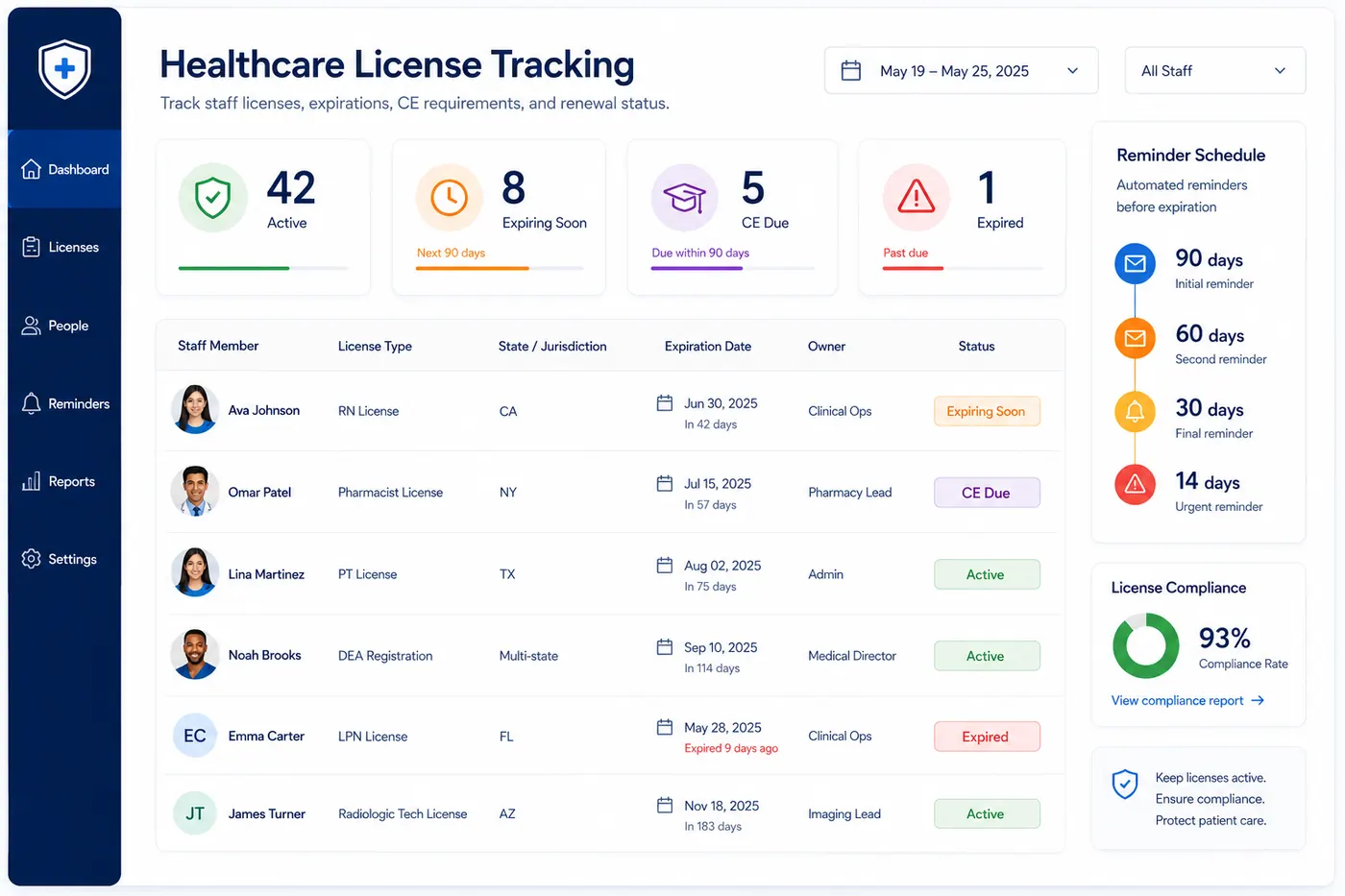
Healthcare license tracking software helps small clinical, HR, and operations teams monitor license expirations, CE dependencies, renewal owners, reminder ladders, and status queues before a lapsed credential affects scheduling, coverage, or patient-facing work.
Healthcare license tracking software keeps license renewal dates, staff owners, CE notes, reminders, and renewal status in one place. The goal is not to replace full credentialing platforms; it is to prevent deadline misses for small teams that need practical visibility.
The best setup treats every clinical license as an operational deadline record. A registered nurse license in one state, a pharmacist license in another state, and a DEA registration should not be hidden inside the same spreadsheet cell or staff profile note.
RenewOps is designed for the small-team layer: enough structure to see risk, assign follow-up, and review upcoming renewals without implementing a full hospital credentialing or privileging system.
This page is the commercial software layer. For a process-first walkthrough, use the healthcare license renewal tracking guide.
When healthcare teams outgrow spreadsheet tracking
A spreadsheet can store license dates, but it does not naturally show which licenses are blocking coverage, which renewals depend on CE completion, or who owns the next action. That gap becomes more visible as the team adds staff, states, departments, or contract requirements.
More than one state
Each state board can have different renewal rules, CE timing, and license lookup steps.
Multiple clinical roles
Nurses, pharmacists, therapists, dental staff, and social workers often need different lead times.
CE documentation matters
A due date alone is not enough when the renewal depends on completed continuing education.
Scheduling depends on status
An expired or blocked license can affect coverage, staffing, or patient-facing work.
Healthcare license records teams often track
| Record | Source | Renewal note | Reminder ladder |
|---|---|---|---|
| Registered nurse license | State board | CE required | 90 / 60 / 30 / 14 |
| Pharmacist license | State pharmacy board | CE + renewal form | 90 / 60 / 30 / 14 |
| Physical therapy license | State board | CE required | 60 / 30 / 14 / 7 |
| DEA registration | Federal registration | Separate renewal cycle | 90 / 60 / 30 |
| Dental license | State dental board | CE + fees | 90 / 60 / 30 / 14 |
| Social work license | State board | CE required | 60 / 30 / 14 / 7 |
How to organize a healthcare license portfolio
The cleanest model is one record per license or registration, with the staff member, role, issuing state, expiration date, renewal requirements, owner, and reminder ladder visible together. That gives the team a portfolio view without losing the detail needed for each renewal.
What each healthcare license record should contain
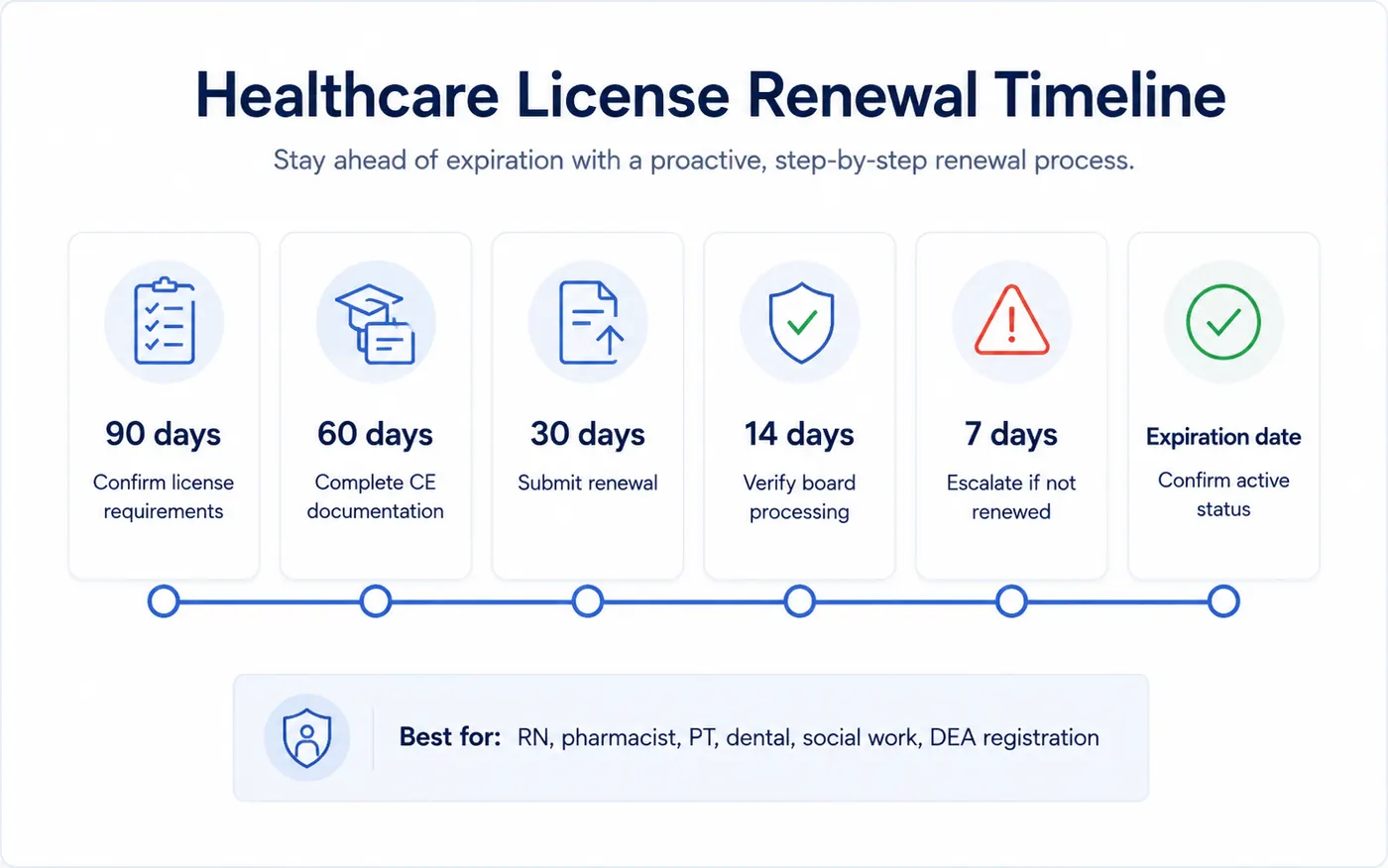
A lightweight healthcare license renewal workflow
01
Create one record per license
Do not combine multiple state licenses or registrations into one row.
02
Capture renewal requirements
Track expiration date, renewal date, CE requirement notes, owner, and status.
03
Assign the accountable owner
Set who owns follow-up: staff member, manager, credentialing coordinator, or operations lead.
04
Use early reminders
Clinical licenses often need 60 to 90 days because CE and board processing take time.
05
Review weekly
Work expiring-soon and expired license queues before they affect scheduling or patient care.
What a weekly healthcare license review should answer
A useful review is short and action-oriented. The team should be able to answer which licenses are expired, which are expiring soon, which require CE or documentation, and which owner needs to act before the next review.
This is where a status-first system helps more than calendar reminders alone. Reminders tell one person about one deadline; the dashboard shows the team whether the whole renewal portfolio is under control.
Where this fits with license and credential tracking
Healthcare license tracking is a specialized subset of license expiration tracking. It focuses on clinical licenses, CE deadlines, role coverage, and staff-level accountability.
For broader license categories, use license expiration tracking software. For staff certifications and recertification cycles, use certification expiration tracking or staff credential tracking software.
FAQ
Healthcare license tracking software helps small clinics, practices, staffing teams, and operations teams monitor clinical license expiration dates, assign owners, and send renewal reminders before staff credentials lapse.
No. RenewOps is a lightweight renewal tracking system. It helps teams track deadlines, owners, reminders, and status, but it does not replace full hospital credentialing, primary-source verification, or privileging platforms.
Teams can track nursing licenses, pharmacist licenses, dental licenses, physical therapy licenses, social work licenses, DEA registrations, and other clinical renewal records.
A practical cadence is 90, 60, 30, and 14 days for high-risk clinical roles. Shorter 60, 30, 14, and 7 day ladders may work for simpler renewals.
Small teams usually assign portfolio visibility to operations, HR, or a credentialing coordinator while keeping individual license follow-up assigned to the staff member or manager responsible for renewal completion.
Yes. Each state license should be tracked as its own record so expiration dates, CE notes, renewal requirements, and reminders do not get mixed together.
If CE completion is a real dependency, it should be visible in the same license record through notes, review dates, or renewal requirements. That helps teams act before the final license deadline.
Need role-specific guidance? Continue with nursing license renewal tracking .